RosewoodHeartWood: History and Cultural Value in Chinese Incense
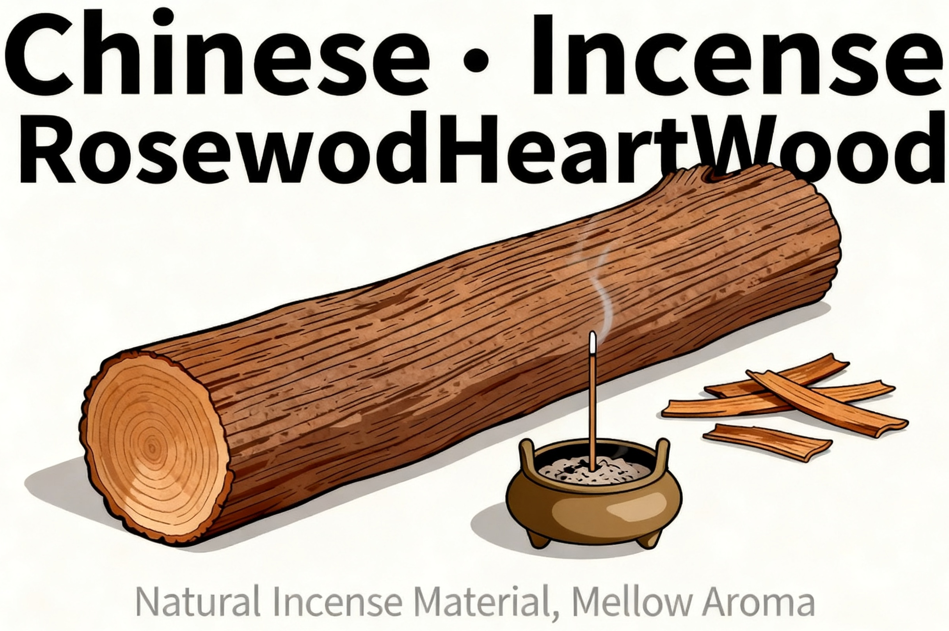
Basic Introduction and Different Names of RosewoodHeartWood
RosewoodHeartWood, also known as Jiangxiang, JiguXiang, ZitengXiang and Jiangzhen in ancient Chinese records, is divided into three main types: FanJiang, GuangJiang and TuJiang. For thousands of years, RosewoodHeartWood has been one of the most essential materials for traditional Chinese incense making and ancient cultural rituals. Due to the ancient historical name ZitengXiang used to describe RosewoodHeartWood, many people once confused this precious incense material with the common legume plant Ziteng. Some people also mistakenly believed that the botanical plant Shanyougan from the Rutaceae family was the ancient RosewoodHeartWood. In fact, the real plants that can produce genuine RosewoodHeartWood all belong to the Dalbergia genus of the legume family, including Liangyue Huangtan, Xieye Huangtan and Hongguo Huangtan. In addition, other woody varieties such as Xiaohua Huangtan, Yindu Huangtan and Jiangxiang Huangtan are also commonly referred to as Jiangxiang or RosewoodHeartWood in folk tradition.
RosewoodHeartWood Status: Equal to Agarwood and Sandalwood in Ancient Incense Culture
RosewoodHeartWood is a classic and precious traditional incense material with important cultural status. In ancient times, it was equally famous and valued alongside agarwood and sandalwood in Chinese incense culture. In traditional ancient incense making, especially when crafting seal incense with pure agarwood powder, a small amount of RosewoodHeartWood must be added. This simple blending step can elevate the fragrance quality, bringing out the most authentic, purest and most refined natural aroma effect, making the overall incense scent more layered and mellow.
Tribute History: RosewoodHeartWood as Ancient Foreign Royal Tribute
In ancient dynasties, RosewoodHeartWood was a precious tribute presented by overseas countries to the Chinese imperial court. The main tribute material was the heartwood of Yindu Huangtan, which was recorded as FanJiang imported from overseas in the classic ancient book Bencao Gangmu. Huang Shengzeng, a scholar in the Ming Dynasty, detailed the tribute history of RosewoodHeartWood in his work Xiyang Chaogong Dianlu. Among the tribute gifts from twenty-three Southeast Asian countries recorded in the book, RosewoodHeartWood was almost always included. For example, during the Zhengtong period of the Ming Dynasty, the country of Zhancheng sent envoys to pay homage to the Chinese emperor, and their tribute list included ivory, rhinoceros horn, QiNanXiang and TuJiangXiang. Apart from imported overseas supplies, RosewoodHeartWood also grew locally in China, mainly distributed in Hainan, Guangdong, Guangxi and Yunnan provinces.
Ancient Document Records: Early Descriptions of RosewoodHeartWood in Song and Ming Dynasties
Shen Maoguan, a scholar in the Ming Dynasty, described the traits and characteristics of RosewoodHeartWood in his workHuayi Huamu Niaoshou Zhenwan Kao, which recorded plants from Guangdong, Guangxi and Vietnam. He wrote that RosewoodHeartWood had thick and solid texture, layered stems like bamboo roots, slender leaves, white flowers and black seeds. A special feature was that placing this wood in wine could keep the liquid from spoiling for twenty to thirty years. In the Song Dynasty, Chen Jing quoted content from Nanzhou Ji in his classic incense book Chen Shi Xiang Pu, stating that RosewoodHeartWood grew in the mountains of Nanhai and Daqin regions and was believed to ward off negative energy and bad luck. Ye Tinggui also mentioned that RosewoodHeartWood originated from Sanfoqi and Haifu areas, with a strong and long-lasting aroma. In ancient folk tradition, every New Year season, every family, rich or poor, would burn RosewoodHeartWood like firewood to purify the home atmosphere.
Historical Materia Medica Records: Quality Standards and Aroma Characteristics
Many ancient medical and botanical books clearly recorded the quality classification and aroma traits of RosewoodHeartWood. According to the Bencao Gangmu compiled by Li Shizhen, based on Xi Man Cong Xiao written by Zhu Fu in the Song Dynasty, JiguXiang was another name for Jiangxiang, originally produced in Hainan. The wild varieties grown in remote mountainous areas were similar in appearance but thinner in texture with a lighter fragrance. In the Yuan Dynasty, Zhou Daguan wrote in Zhenla Ji that RosewoodHeartWood was the core heartwood of large trees in the jungle, requiring great effort for locals to cut and harvest. The outer bark was very thick, and the wood released a strong and far-reaching fragrance when burned.
Bencao Gangmu also noted that genuine high-quality RosewoodHeartWood came from southern Guizhou and Nanhai areas, with a scent similar to Sufangmu. It did not smell strong when burned alone, but became extremely fragrant and charming when blended with other natural incense materials. The best quality was FanJiang with a purplish-red color and moist texture. In the Ming Dynasty, Miao Xiyong also mentioned in Shennong Bencao Jing Shu that RosewoodHeartWood had a clear and intense pure fragrance, capable of dispelling bad and unlucky energy. Imported FanJiang had a sweet and gentle aroma, making it the top choice for traditional use.
Cultural and Taoist Spiritual Meaning of RosewoodHeartWood
RosewoodHeartWood has profound spiritual cultural connotations. Wu Yiluo in the Qing Dynasty wrote in Bencao Cong Xin that burning this incense could invite divine spirits down to the mortal world, which is where its name originated. For this reason, Taoism highly respected RosewoodHeartWood and often used it in grand religious rituals to connect with heaven and invite divine blessings. Taoist culture believed that burning RosewoodHeartWood could attract celestial cranes, a symbol of good fortune and spiritual fulfillment.
Liu Xiang in the Han Dynasty recorded in Lie Xian Zhuan that burning RosewoodHeartWood could attract cranes and was the best incense for worshipping stars and celestial beings. It was also believed that children wearing sachets made of this incense could ward off negative energy. In the Five Dynasties period, Li Xun wrote in Haiyao Bencao that RosewoodHeartWood had a mild nature and could purify home surroundings and create a peaceful living atmosphere.
Resource Depletion: Scarcity and Replacement by Huanghuali Wood
Due to excessive felling and extravagant use by royal courts and noble families throughout history, wild RosewoodHeartWood resources were almost completely depleted. Today, genuine wild RosewoodHeartWood is hardly found in accessible mountain areas. For this reason, people began using Huanghuali wood as a substitute because it has a similar color and similar natural fragrance. Huanghuali, also written as Huanghuali, belongs to the Dalbergia genus of the legume family, so it is also named Jiangxiang Huangtan. This tree has a thicker trunk and is extremely precious, widely used for making classical royal furniture in ancient times.
Although Jiangxiang Huangtan has a similar fragrance to RosewoodHeartWood, its aroma layering and traditional incense making effect cannot compare with genuine RosewoodHeartWood. Jiangxiang Huangtan is mainly distributed in the western and southern mountainous areas of Hainan, with obvious differences in wood quality due to growing environment. The darker, oily core wood produced in western Hainan is called Youge, while the lighter, less oily wood from eastern Hainan is called Kangge, with different market values and aroma qualities.