Agarwood Guide: Types, Qi Nan Incense & Origin Scents (Complete Overview)
1.What is agarwood?
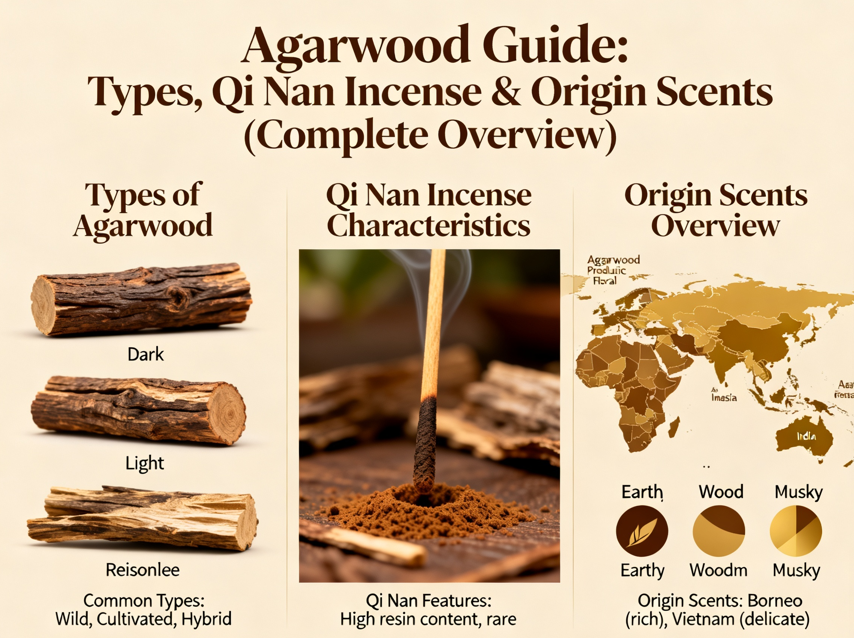
Agarwood, also known as ‘Chen Shui Xiang’ (water-soaked agarwood) or ‘Shen Xiang’. In ancient times, the characters ‘Shen’ and ‘Chen’ were often used interchangeably, so ancient texts frequently referred to it as ‘Shen Mu Xiang’, ‘Shen Shui Xiang’, ‘Shui Shen’, ‘Shen Xiang’, and so on. When people commonly say ‘Chen Tan Long She’, the ‘Chen’ refers to agarwood. In ancient times, people also referred to agarwood based on its fragrance characteristics as ‘Mu Mi’ (wood honey) or ‘Mi Xiang’ (honey fragrance).
Agarwood is a species of the genus Aquilaria in the family Thymelaeaceae. After reaching a certain age, it suffers injuries due to external forces, gets infected by fungi and microorganisms, and the wounds rot into lesions. The resin glands are stimulated to secrete a large amount of resin, forming a paste or crystalline substance at the wound site.
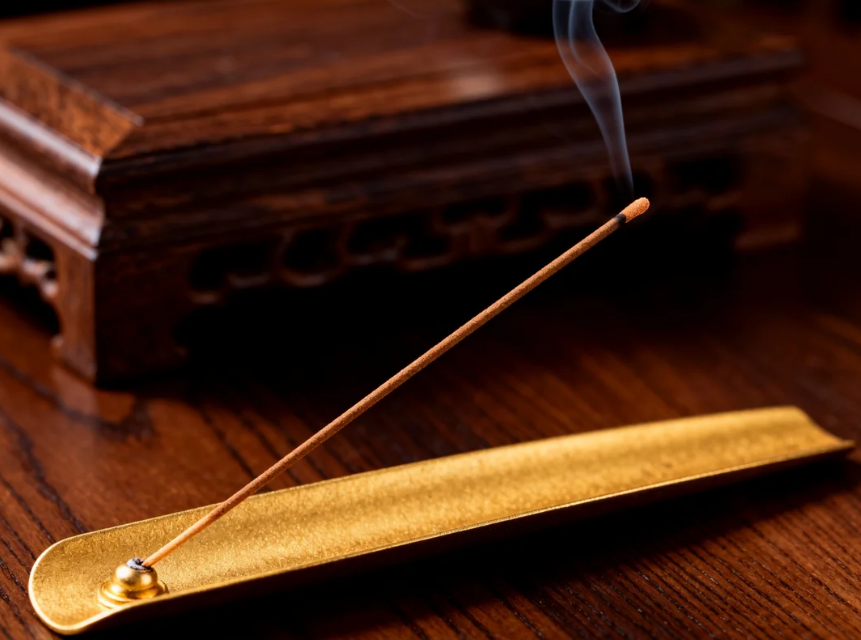
Agarwood has a faint fragrance at room temperature, but when burnt, it becomes rich, cool, elegant and mellow, and its scent persists for a long time. Moreover, due to its long formation process and rarity, it has been regarded as the foremost among fragrances and admired by people throughout history. Although agarwood is produced in the hot and humid southern regions, it does not have a pungent smell; instead, it is cool, gentle, and refined, with effects that other aromatic herbs cannot replace, making it one of the most important raw materials in the production of high-quality incense.
Unlike sandalwood, agarwood is not a type of timber, but a solid condensation produced by a special fragrant tree, combining resinous (oil) substances with woody components. Moreover, the wood of these fragrant trees does not have a distinct scent and is relatively soft. According to research, a few species of trees in the Aquilaria genus, such as the Malay agarwood tree, the Gyrinops tree, and the Indian agarwood tree, can all produce agarwood. Agarwood has also been recorded in literature very early. During the Eastern Han Dynasty, Yang Fu made an accurate description of “wood honey” in his record of Lingnan products, “Yiwu Zhi”: ‘The fragrant wood called Xiangshu lives for a thousand years, its roots are very large. Initially cut down when still a sapling, after four or five years it is examined. Over time, the roots of poor trees decay, only the central section remains firm and pure, and its fragrance alone endures.’
The formation of agarwood is extremely complex. The formation of natural agarwood is uncertain; even among several adjacent trees of the same species, some may produce resin while others do not. As Zhang Shizheng noted in the Song dynasty in “Juanyou Lu”: “Agarwood trees are abundant in the coastal regions of Lingnan. The large ones can be embraced by two arms, and locals sometimes use them for houses, bridges, or rice steamers, yet only a few produce fragrance.” Through long-term practical experience and research, people have found that only when the agarwood tree itself develops certain diseases, or its roots and branches are attacked by insects or animals, or injured by human activities such as logging, will the yellow-green mold fungus grow or parasitise on it. This triggers a series of internal changes in the tree, causing components like gum, resin, and essential oils to gradually accumulate and deposit, forming a “resin knot.” Generally, “resin knots” are further categorised into “ripe knots” and “raw knots.” “Ripe knots” usually refer to resin formation caused by the tree’s own disease, while “raw knots” result from injuries caused by animals gnawing, or natural disasters such as lightning strikes and fire, or human-inflicted damage that prompts the tree to secrete resin and form fragrant knots.
The lifespan of natural incense trees can reach several hundred years, and agarwood preserved after the tree falls often also lives for several hundred years, which is why the ancients often praised agarwood as “a substance that gathers the spiritual essence of a thousand years of heaven and earth.” However, natural incense trees usually need to grow for ten or even several decades to develop fully formed resin glands capable of producing “incense knots,” and these “incense knots” require a long period to truly mature. Generally, the longer an “incense knot” has formed, the better its quality. Usually, even after an incense tree has fallen, withered, or died, it can still form dense, compact masses. Even with prolonged immersion in water, burial in soil, corrosion, and decomposition, the quality of the “incense knot” may improve further. Thus, it is clear that the quality of “ripe incense” naturally formed over many years buried in soil or soaked in water is superior to “raw incense” harvested before it has fully matured. Nonetheless, there are opposing views. For instance, Chen Jing of the Song dynasty, in “Xinzuan Xiangpu: Agarwood of Sinking Water,” quoted Ye Tinggui as saying: “Generally, freshly formed knots are the best, matured ones come second; firm black is superior, yellow comes next.” Such differences may arise from varying interpretations of what constitutes “fresh knots” and “mature knots.”
It is generally believed that agarwood that can appear yellow, brown, dark green or black, and that sizzles with oil when burnt, has higher resin and oil content. In fact, this method is not reliable and can only be used as a reference at best. Apart from the oil content, factors such as maturity and the scent characteristics caused by the growing environment also need to be considered. In practice, although more essential oil can be extracted from agarwood with higher resin and oil content, or the aroma may be stronger, the quality of the fragrance and its medicinal effects are not necessarily better. This is because the formation of agarwood is complex and lengthy, and its quality is the result of multiple factors. In other words, the quality of agarwood depends on several factors including tree species, age, fungi, climate, soil and environment. Additionally, agarwood formed in different parts of the tree can have subtle differences in aroma. For example, Lu Dian in “Zengxiu Biya Guangyao” classified agarwood into the following types: ‘Honey fragrance, Agarwood, Chicken-bone fragrance, Yellow-mature fragrance, Stack fragrance, Green-cinnamon fragrance, Horse-hoof fragrance, Chicken-tongue fragrance. According to this, all eight fragrances come from the same tree.’ “Bencao Gangmu Jiji” also states that agarwood, chicken-bone, yellow-mature, chicken-tongue, stack, spine-cinnamon, and horse-hoof fragrances all come from a single tree. Those formed in the heartwood and knots that are black and sink in water are called agarwood, while those that partially sink are chicken-bone fragrance; formed at the tree roots are yellow-mature fragrance; on the trunk are stack fragrance; on solid, unopened small branches are green-cinnamon fragrance; those at large, light root knots are horse-hoof fragrance: flowers without aroma but fruit aromatic are called chicken-tongue fragrance.
Agarwood plays an important role in traditional incense making as it ‘harmonises various scents’. The production of traditional incense is very similar to the use of Chinese medicine, also emphasising the compatibility of principal, minister, assistant and courier components. In other words, the role of agarwood in the blending of incense is akin to the use of licorice in Chinese medicine, which is commonly employed to ‘harmonise the herbs and prevent conflict’, balancing the properties of various aromatic substances to create a unified whole, which is why it is often praised as the ‘elder statesman of incense’.
In fact, agarwood itself has been a very important medicinal material since ancient times, with effects such as reducing qi and eliminating dryness, warming the kidneys and nourishing the spleen, regulating qi and countering adverse effects, and assisting yang energy. Li Shizhen noted in Compendium of Materia Medica: ‘Agarwood, pungent in flavour, slightly warm, non-toxic. It treats wind and water toxins and swellings, dispels evil qi. It is used for heart and abdominal pain, cholera, and for evil spirits causing itching. It clears the mind, and is suitable for boiling in wine for consumption. Various sores and swellings can be treated with it included in ointments. It harmonises the middle, nourishes the five organs, benefits essence and strengthens yang, warms the waist and knees, stops cramps, vomiting, diarrhoea, cold conditions, dispels obstruction and numbness, alleviates rheumatic itchy skin, treats dysentery, nourishes the right kidney and the life gate. It strengthens the spleen and stomach, and treats phlegm, saliva and blood disorders from the spleen. It benefits qi and harmonises spirits. It addresses heat above and cold below, counterflowing qi with rapid breathing, large intestine deficiency, urinary leakage, and coldness of male essence.’ According to Essentials of Materia Medica, agarwood ‘can descend qi and dispel phlegm and saliva (when anger rises, qi goes upwards; if it can calm, it descends qi); it can descend or ascend. It warms essence and assists yang, promotes qi without harming it, warms the middle without enhancing fire.’ The Harmonised Classics of Shennong also states: ‘It harmonises the middle, nourishes the five organs, benefits essence, strengthens yang, and warms the waist and knees.’ Therefore, many famous patent medicines require agarwood, and there are also many prescriptions directly named after agarwood, such as various agarwood pills, agarwood powders, and agarwood decoctions.
In ancient times, agarwood was often used to make various health-promoting beverages. For example, the Song Dynasty’s ‘Heji Ju Fang’ records a ‘Tiaozhong Agarwood Decoction’, made into powder with agarwood, musk, borneol, licorice, and other ingredients. When used, it is brewed with boiling water, and ginger slices, salt, or wine can also be added. ‘Taking it brings great benefits’ and can treat symptoms such as ‘poor appetite and fatigue in the limbs’. It also promotes health and beauty, ‘regulates the middle and smooths qi, expels pathogens and nourishes righteousness’, and ‘taking it regularly with diet harmonises the internal organs, refreshes the skin, and improves complexion’.
In addition, agarwood holds a high status in Buddhism and is one of the main incense materials used for worship and bathing of the Buddha. Incense made from agarwood is a premium choice for use during meditation. Prayer beads and Buddha statues carved from agarwood are valuable Buddhist items. The “Shurangama Sutra” also records the story of Xiang Yan Tongzi attaining enlightenment through the fragrance of agarwood. Some densely formed agarwood is also considered superior carving material. Agarwood carvings typically have a simple, rich colour and a unique charm, highly esteemed by people. As mentioned earlier, Su Shi once gifted his brother Su Zhe an agarwood hill from Hainan as a present to celebrate his sixty-year birthday.
2.Qi Nan incense
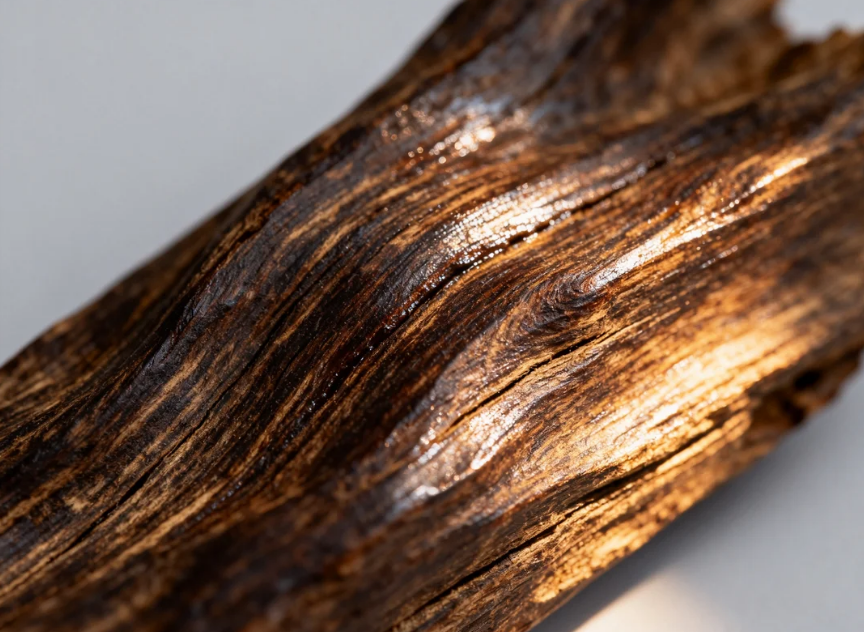
There is a special category within agarwood, which is often regarded as a unique type called Qi Nan. The term “Qi Nan” is an abbreviation of the Sanskrit word ‘tagara,’ and it is also known as ‘Duo Jia Luo,’ ‘Jia Nan,’ ‘Jia Lan,’ or ‘Qi Nan Xiang,’ which can be translated as ‘incense wood.’ The formation of Qi Nan is basically the same as ordinary agarwood, but their characteristics differ in many ways. Qi Nan has a higher resin content than ordinary agarwood, and its fragrance is sweeter and richer, so it is habitually treated as a separate category or considered a top grade of agarwood. Qi Nan is generally less dense than ordinary agarwood (hereinafter referred to as agarwood); while agarwood sinks in water, many high-grade Qi Nan pieces are semi-floating. Most agarwood has a hard texture, whereas Qi Nan is softer and can be “cut like clay, chewed like wax,” with a certain stickiness, allowing fragments or shavings to be rolled into balls. Under a microscope, the resin glands in agarwood usually cluster together, whereas in Qi Nan, they are dispersed. Most agarwood has almost no scent when unlit, while Qi Nan emits a refreshing and sweet aroma even before burning. During burning, agarwood’s fragrance is generally very stable, whereas Qi Nan’s aroma often changes noticeably, with distinct top, middle, and base notes. All these factors, combined with the fact that Qi Nan is rarer than agarwood, make it especially precious. During the Song Dynasty, Qi Nan from Champa (present-day Vietnam) was already extremely valuable. Even today, the best Qi Nan mostly comes from Vietnam. However, it is worth noting that although Qi Nan has many advantages, it is not a grade designation; in other words, Qi Nan is not necessarily superior to other agarwood.
Qinan is classified by colour into white Qinan, green Qinan (also called blue Qinan), yellow Qinan, and black Qinan.
White Qi Nan: Named for its relatively white surface, it is the rarest type. Its fragrance is unique, the texture extremely soft, and it numbs the tongue when tasted but causes no discomfort, making it the most expensive top-grade Qi Nan. The bark of white Qi Nan with wood is golden fibre, while inside it has dense resin, which turns brown or dark brown.
Green Qinan (Green Rare Agarwood): Its shapes vary, with the flower-shaped ones being the most special, featuring a reddish-brown sheen. The outer layer resembles petals, while the inner layer looks like the stamen, commonly known as flower Qinan, and is also a premium type of Qinan. Green Qinan is soft in texture, causing a numbing sensation on the tongue with a slight stickiness; when burned, it emits a rich and long-lasting fragrance.
Yellow Qinan: Its colour is mostly green-black with yellow streaks, fragrant in taste, soft in texture, with a numbing sensation on the tongue, and its quality is slightly inferior to that of Bai Qinan and Qing Qinan.
Black Qi Nan: its colour is darker, the texture is harder, with characteristics of fragrance and numbness, and the quality varies.
Qinan is classified by its characteristics into Yinge Green, Orchid Knot, Sugar Knot, Golden Silk Knot, and Iron Knot.
Yingge Green: commonly known as Green Chess, its cut surface is dark green, mixed with a little yellow, resembling the feathers of a yellow-green oriole with a shiny green hue. Its scent is fragrant, and enjoying it through an incense burner offers the finest olfactory pleasure.
Orchid Knot: commonly known as Ziqi or Miqi, it has characteristics similar to Yingge Green, but the fragrance is slightly different. Yingge Green has a rich and variable aroma, whereas Orchid Knot has a sweet scent reminiscent of fruit.
Sugar knot: commonly known as Red Chess, its cut surface is yellow-brown, with a sweet fragrance, and it is an orchid knot that is less than a year old.
Golden Silk Knot: commonly known as Yellow Qi, with a cross-section that is mostly yellow with a little green, the aroma is good but not long-lasting, indicating it is a young Yingge Green.
Tie Jie: commonly known as black agarwood, it has relatively hard oil, usually tastes cool, and its fragrance does not last long. Black agarwood can be found in live aloeswood and is the cheapest among Qinan, mostly used for medicinal purposes.
Ancient books state that genuine rare agarwood incense is extremely scarce, and therefore its price is several times that of gold. However, if someone wears a small amount of rare agarwood incense, as soon as they take their seat, the entire hall will be filled with a rich fragrance, and even after the person wearing the incense leaves, the scent will not dissipate.
3.The scent type, origin and characteristics of agarwood
Good incense must have a good taste. A good scent is an important criterion for judging high-quality agarwood. The standards for evaluating agarwood quality are in order: incense, texture, shape, and colour. Some agarwood, although high in oil content and dense enough to sink in water, may have sour or musty aromas. Focusing only on texture without considering incense cannot effectively identify high-quality agarwood.
The fragrance of agarwood has distinct geographical characteristics. The closer the place of origin is to the equator, the stronger the scent; the farther from the equator, the milder and sweeter the aroma. The content of aromatic compounds varies in agarwood from different origins. Due to differences in origin, climate, geology, soil and atmospheric conditions also vary, so even within the same species of agarwood, the quality produced differs. As the saying goes, ‘Oranges in the south and bitter oranges in the north, the difference is in the soil and water.’
Agarwood, classified by place of origin, is divided into three main scent types: Hainan, Hui’an, and Singapore.
Characteristics of agarwood incense
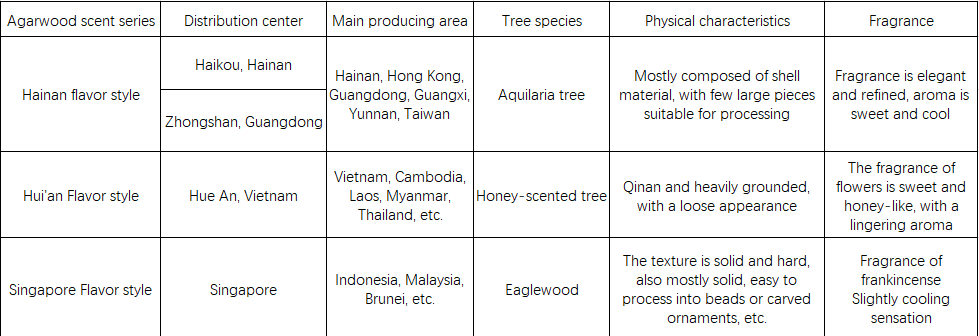
(1) Hainan flavour style
1) Hainan Agarwood
Hainan agarwood, also known as cliff incense or qiongzhi, is both a precious medicinal material and a top-quality spice.
The geographical environment is a key factor in determining the quality of agarwood. In China, agarwood mainly grows in the hilly and mountainous areas south of 22°N latitude, where winter temperatures do not fall below 3°C and the annual average temperature does not drop below 20°C. In addition to having an environment suitable for agarwood growth, Hainan also possesses volcanic conditions superior to other regions, which are conducive to the production of high-quality agarwood. The island is located in a tropical maritime monsoon climate zone, with coastal areas and river estuaries experiencing frequent wind, rain, thunder and lightning, abundant rainfall, significant day-night temperature differences, rich vegetation, warm conditions all year round, and active ants. An important reason why Hainan agarwood is regarded as the best in the world is that the unique tropical island climate of Hainan is extremely suitable for the growth of Aquilaria trees, often producing top-quality agarwood.
The trees producing agarwood in China are mainly the whitewood agarwood tree of the Thymelaeaceae family. The whitewood agarwood tree, also known as the guanxiang tree, is a unique species in China and was historically widely distributed in Hainan and the Guangdong regions. The agarwood it produces, compared with imported agarwood from other species in Vietnam and Indonesia, is often referred to as native agarwood. Of course, some also refer to agarwood from dead trees that are buried in soil to mature as ‘native agarwood’. Although generally the oil content of ‘native agarwood’ is usually lower than that of imported agarwood, its fragrance is of very high quality, and premium agarwood has a high specific gravity. For example, during the Northern Song Dynasty, Ding Wei remarked that in terms of smoke, imported incense ‘its furnace smoke is dense but does not rise’; Hainan incense, however, ‘its tall smoke and faint fragrance stretch as if drawn by a bundle’. In terms of aroma, imported incense is ‘dry and light, lean and withered’; Hainan incense is ‘rich, smooth and resinous, like tempered lacquer, with a lasting and delightful fragrance’. Historically, many people in Hainan made a living from harvesting agarwood. Hainan-produced agarwood has a very high reputation. For instance, Lu You wrote in “Taiping Era” that: ‘In the bamboo-lined rooms, a path runs deep, in quietude after reading “Lanting”, there is nothing to do but practice the zither. In a bronze censer, smoke rises doubly. Scattered blooms fly, green shade forms, and birds sing. The wafting aroma of Hainan incense cleanses my attire.’ Here, ‘Hainan incense’ refers to Hainan agarwood. Agarwood from Limu Mountain in Hainan is also praised as ‘the best in the world’. For example, Cai Tiao wrote in “Discussions on Tiewei Mountain”: ‘(Agarwood from) Champa (Vietnam) is not as good as that from Chenla (Cambodia), and Chenla’s is not as good as the Li villages in Hainan. Yet the best of them all is the agarwood between Wanan and Jiyang, from Limu Mountain, which is unparalleled worldwide.’ Fan Chengda also stated in “Guanghai Yuheng Zhi: Zhi Xiang”: ‘In water-sinking agarwood, the best comes from Limu in Hainan… Generally, the fragrance of Hainan agarwood is pure and gentle like lotus, plum blossom, young goose feathers or honey. Burning a censer of it fills the hall with fragrance, which permeates the surroundings, and even when it is near extinguished, the scent is not burnt, this is the distinction of Hainan agarwood… People from the central plains use only imported agarwood from Champa or Chenla, and in recent years the more expensive import from Dingliu, I have tried it, but it does not match even the medium or low grade of Hainan agarwood.’ Su Shi highly praised Hainan agarwood in his “Ode to Agarwood Mountain,” saying: ‘Knowing the unique product of Danya, it is truly exceptional and in a class of its own. It is as hard as gold yet jade-like, with crane-like bones and dragon-like tendon. Its resin is abundant, so it is firm and heavy. As for Champa’s decayed wood, it is only suitable to be used for cooking or repelling mosquitoes.’ He even believed that Champa agarwood cannot be compared to Hainan agarwood, and at most is suitable for burning for firewood or fumigating insects. Although this statement may seem exaggerated, it helps us understand that the quality of Hainan agarwood at the time was indeed extraordinary.
By the Qing Dynasty, due to Hainan agarwood gradually transforming from a tribute to the imperial court into a commercial product, driven by enormous economic interests and coupled with inadequate government regulation, overexploitation intensified, leading to the depletion of Hainan agarwood resources, with production less than one-tenth of that in Vietnam. During the Kangxi period of the Qing Dynasty, local official Zhang Zhuoshi of Yazhou once submitted a memorial recommending the regulation of agarwood harvesting. He earnestly pointed out: ‘All the Li people know that an inch of agarwood can fetch an inch of gold, which exhausts the resources of agarwood trees. If we wait for them to regenerate and bear fruit again, it will take hundreds or even thousands of years and it is hard to hope for the recovery of this precious material.’ As he foresaw, it is indeed very difficult today to see traces of wild Hainan agarwood trees. Although before the 1980s, the state had listed it as a national second-class protected plant and implemented protective measures such as centralized control of Hainan agarwood by the national medicine company, prohibiting private sale, these measures were still ineffective and failed to fundamentally reverse the endangered situation of this wild tree species.
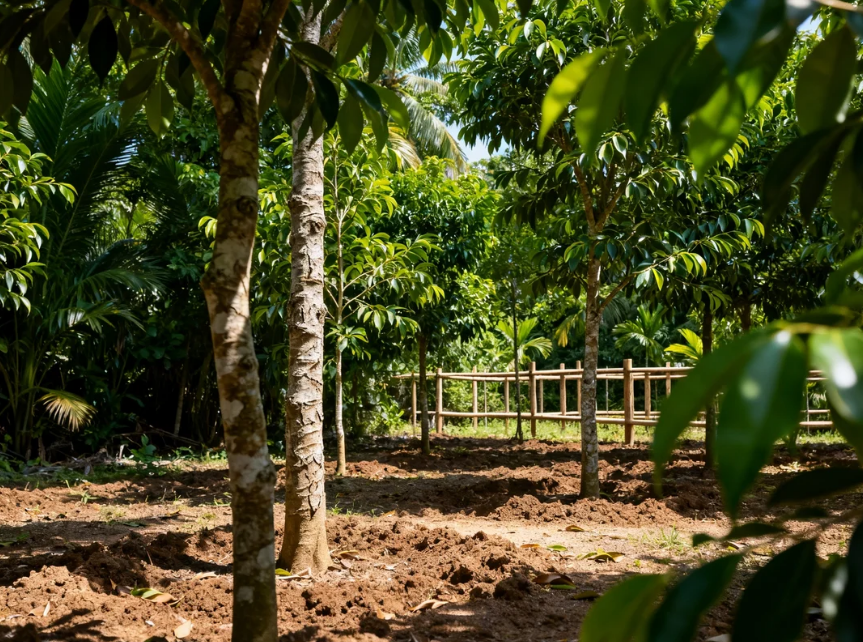
In recent years, many countries and regions that produce agarwood have recognized the economic value of agarwood and the seriousness of rampant overharvesting, and have taken various measures to actively carry out the restoration of agarwood trees. Since people have understood that the formation of agarwood requires three necessary conditions—having a tree from the Thymelaeaceae family, the tree having wounds, and the introduction of a fungal strain (an endophytic fungus from the agarwood tree with a special function that promotes and induces resin formation in the whitewood agarwood tree—the yellow-green Auricularia fungus)—harvesters in regions such as Hainan have now largely mastered the techniques of artificial agarwood cultivation and synthetic agarwood resin production.
2) Guangdong Dongguan incense
Apart from Hainan, the ancient Dongguan County area was abundant in camphor, toothache trees and daughter fragrance, which were mainly used as spices and medicinal herbs.
According to historical records, Mu Xiang (also known as Guan Xiang, White Mu Xiang, or Tu Chen Xiang) was introduced to Guangdong during the Tang Dynasty and was widely cultivated during the Song Dynasty. Because it was mainly concentrated in the Dongguan area, it was also called Guan Xiang. The resin produced by the Guan Xiang tree has a unique fragrance. After the trees have grown for six to seven years, people dig them up with their roots and process them into blocks for sale. During festivals, every household in the region would buy some Guan Xiang blocks and place them in incense burners. The blocks do not produce open flames; they slowly burn and turn to black charcoal, releasing fragrant tendrils of smoke that are highly favoured.
Legend has it that the washing and drying of agarwood were usually handled by young women, who often secretly kept the best pieces on themselves in exchange for cosmetics, thus giving rise to the name of the finest fragrance, “daughter’s scent”.
Dongguan is not only prosperous in agarwood cultivation, but the quality of agarwood it produces is also very high, making the industry a local pillar. Hence, the agarwood produced there is called ‘Guan incense’, ‘local agarwood’, or ‘white agarwood from Guangzhou’s flower market and Luofu’s medicine market, now belonging to Guangxi’. During the Ming and Qing dynasties, the incense market in Liaobu, Dongguan, and the pearl market in Hepu were collectively known as the ‘Four Markets of Eastern Guangdong’. In ‘Guangdong New Records·Incense Notes·Guan Incense’, Qu Dajun of the Qing dynasty recorded: ‘During the peak of Guan incense, it sold for over tens of thousands of gold annually. In the Su (Suzhou) and Song (Songjiang) regions, every Mid-Autumn Evening, the incense would be burnt from dusk till dawn in a ceremony called ‘Xun Yue’. The accumulation of Guan incense at Changmen would be used up in one night, so many people in Dongguan started their fortunes with incense.’
As is well known, the origin of place names in Hong Kong is also related to agarwood. During the Ming Dynasty, Hong Kong was under the jurisdiction of Dongguan, a place for the collection and transportation of agarwood (Dongguan incense). At that time, both its harbour and surrounding areas were covered with agarwood, so Shipai Bay (now Aberdeen) was called “Xiangbutou” and Tsim Sha Tsui (formerly Tsim Sha Tau) was also named in the Wanli period of the Ming Dynasty, as recorded in Guo Bei’s “Yue Daji”. This is where the name “Hong Kong” comes from. Nowadays, place names in Hong Kong include “Stanley” and others. In the early Qing Dynasty, the “Tiekeng” annotation in the “Coastal Map of Guangdong” already marked “Hong Kong”. To cut off connections between coastal areas and Zheng Chenggong, a large-scale sea relocation policy was implemented, forbidding residents from living within tens of miles along the coast, forcing Hong Kong residents to move inland, leading to the decline of the incense business.
In recent years, the cultivation of agarwood in Dongguan has developed rapidly. The Dongguan municipal government has extensively propagated and promoted agarwood as a local emblematic plant, and the long-missed agarwood will soon fill the land of Dongguan with its fragrance.
(2) Hui’an flavour system
Hui’an is an ancient town in Vietnam. Vietnam is what is referred to as the Champa Kingdom in the Ming History. The local honey-scented trees in Vietnam are all found in the central mountainous region. Since in ancient times the agarwood produced in Vietnam was traded at the distribution centre in Hui’an, the agarwood from Vietnam is commonly known as Hui’an agarwood.
Considering the interrelation between landforms and various production areas to imagine the mutual spread and evolution of fragrant trees, agarwood trees, like ordinary plants, undergo pollination, dispersal, and crossbreeding. Therefore, in principle, Vietnam is a production area for honey agarwood trees, but the trees in the north crossbreed with Dammar trees, while the trees in the south crossbreed with Eaglewood trees.
The flavour of Huian can be described as “elegant and refined,” characterised by a combination of sweet and cool notes, with fruity or floral aromas, strong penetration, and a thread-like taste. Honey-scented wood, due to its sweetness and soft texture, is easily susceptible to insects, ants, and fungal attacks, and its resin is usually hollowed out by insects, often broken into fragments, brittle in nature, primarily used for incense burning, with very little use in carving.
1) Vietnamese agarwood
Vietnam has multiple regions that produce agarwood, mainly Nha Trang, Phu Son, Da Nang, and Hue.
Nha Trang City is located in Khanh Hoa Province in the central coastal region of Vietnam. It is a relatively quiet and picturesque coastal town. The scent of Nha Trang is rich and varies with changes in temperature and time. Its fragrance is ‘sweet’ and lingering, with a cooling sensation that reaches deep into the body.
The Fusen Mountains are a north-south mountain range in central Vietnam. Fusen red soil agarwood is a premium material in incense. The fragrance of Fusen red soil agarwood is mainly “sweet”, with a long-lasting sweet aroma, rich and mellow, and the sweetness in the scent is extremely powerful, penetrating the lungs and refreshing the mind.
The distinction between yellow clay agarwood and red clay agarwood is actually determined by the scent rather than the colour, because both are honey-scented tree species with oil lines of the same colour, differing only due to the altitude, sand colour, and rock type where they grow.
The agarwood from Shunhua has a strong aroma, with a slight sweetness when smelled. High-grade Shunhua agarwood has a sweet and spicy fragrance with a dense aroma.
2) Laos Agarwood
Laos, known in ancient times as Lan Xang, produces agarwood mainly in the mountains on the border between Laos and Vietnam. In terms of wood appearance, the grain of Laotian agarwood is not as fine as Indonesian agarwood, and its hardness is also not as good as the latter, but it is slightly harder than Hainan agarwood. Many Laotian agarwoods are solid wood, with large pieces suitable for craft carving.
Laos agarwood does not have the rich and domineering fragrance of Indonesian agarwood, nor the refined and serene scent of Hainan agarwood, but somewhat resembles the aroma of preserved plums. Both Laotian and Vietnamese agarwood have a cool fragrance, with the former being cooler, but lacking the distinctive scent of Vietnamese agarwood, so each has its own merits.
3) Thai Agarwood
Thailand was formerly known as Siam. The agarwood produced in Thailand is mostly used to extract fragrant oil. Its agarwood comes in large pieces with coarse grains, and when burned, the fragrance is pungent and overpowering, so it is not very suitable for making incense products. Currently, Thai agarwood is rarely circulated in the market. Agarwood from Qin State can be used for handicrafts.
4) Khmer (Cambodian) Agarwood
Khmer agarwood, also known as Cambodian agarwood, is primarily produced in Pursat Province, Cambodia, and is therefore also called Pursat agarwood, as well as Pursat Qinan or small Qinan. Khmer agarwood is highly valued in the Arab market. Its top-grade mature knots have a very rich scent, sweet with a hint of floral fragrance, with abundant oil and sinking density. The mature knots of Khmer agarwood have a rich flavour, with a strong body and a hint of rose fragrance.
Overall, Cambodian agarwood has a clear aroma, slightly sweet, becomes richer when heated, has a lighter scent when cool, can carry its fragrance far, is fresher than Hui’an agarwood, with a pleasant sweet floral scent.
5) Myanmar Agarwood
Burmese agarwood is very popular among wealthy people in the Middle East and India. It is similar to Vietnamese agarwood in certain qualities, with a strong but not cloying scent that lingers pleasantly.
(3) Singapore flavour style
Singapore agarwood is the collective term used by the Southeast Asian Chinese community for agarwood distributed in Singapore, primarily made up of eaglewood from Malaysia and Indonesia. In earlier years, agarwood from the undeveloped regions of Papua New Guinea has also been included in the Xingzhou flavour category.
1) Indonesian agarwood
Indonesia is located in the equatorial region, with abundant sunlight and rainfall, so agarwood grows very quickly. However, due to frequent natural disasters, many agarwood trees sink into swamps and soil, and once they produce resin, they are large in size and have a very stable fragrance.
Indonesian agarwood has a relatively high density, and nowadays it is often used to make carvings or bracelets.
Kalimantan agarwood has a distinctive floral and fruity aroma, with extremely varied fragrance layers, making it the type of agarwood with the most diverse scent changes. This sweet aroma is invigorating and has a refreshing effect on the mind. In recent years, Indonesian agarwood has accounted for 70% of the Chinese agarwood market.
The southern region of Kalimantan, Malang, is the largest producer of essential oils for export to the Middle East, characterised mainly by swampy terrain, with agarwood being the predominant product.
Daragan (Talagen) is the main production area for agarwood in Kalimantan. Daragan has a diverse terrain and fertile mountain soils, which nurture agarwood trees with their unique flavour. Daragan agarwood (sometimes called “Talagen agarwood”) has a rich and noticeable milky fragrance at room temperature, and its unique sweet and gentle aroma can bring a sense of warmth. The Daragan production area is a premium region for this type of agarwood.
2) Malaysian Agarwood
Peninsular Malaysia (West Malaysia) borders the Southeast Asian peninsula, so some of the agarwood produced in this area has a scent and characteristics slightly reminiscent of the Hui’an scent profile.
3) Brunei Agarwood
Brunei is located on the northern coast of Borneo, the southern coast of the South China Sea, in Southeast Asia. The entire country is divided and surrounded by Malaysia and is also a top-quality agarwood producing area. However, due to its small size, the production of agarwood is not high. The agarwood produced in Brunei is very similar in scent to Indonesian Kalimantan agarwood, with a rich fragrance, gentle coolness, intoxicating floral honey sweetness, and a luscious orchid scent that is the finest of its kind.
The agarwood scent near Brunei is sweet and cool, slightly strong, very similar to that produced in Brunei. Its agarwood has a snake-skin texture, and is therefore also sold and processed as ‘broadly defined Brunei agarwood’.
4.The Classification of Agarwood
Agarwood can be divided into three grades.
First class is sinking: it sinks when placed in water, also known as water sinking.
Second grade is Stack Incense: half-floating and half-sinking when placed in water.
Third grade is yellow-ripe incense: it does not sink when placed in water.
Agarwood can be divided into four categories based on the way the resin forms.
First maturation: The Incense formed from the resin left by trees after they die, slowly solidifying.
Ersheng resin: It is the Incense formed from the resin that oozes from tree wounds after being cut by axe or pick.
Third shedding: the Incense that emerges from the branch after it has decayed.
Sichong incense: a Incense formed due to the corrosion of trees by insects, bacteria, and other factors.